RapidMoM
2.5D Method-of-Moments for planar RF passives on layered substrates.
RapidMoM is a 2.5D Method-of-Moments solver for planar RF passives on layered substrates: PCB and RFIC, from single inductors and transformers to full metal layouts on a real process stack. The formulation is a mixed-potential surface integral equation with an RWG basis, an A-EFIE saddle-point system against the low-frequency breakdown (stable down to DC), layered-media Green's functions in the Michalski-Mosig formulation, and a kernel-independent ACA / H-matrix fast solver with block-GMRES in O(N log N).
Converging the network
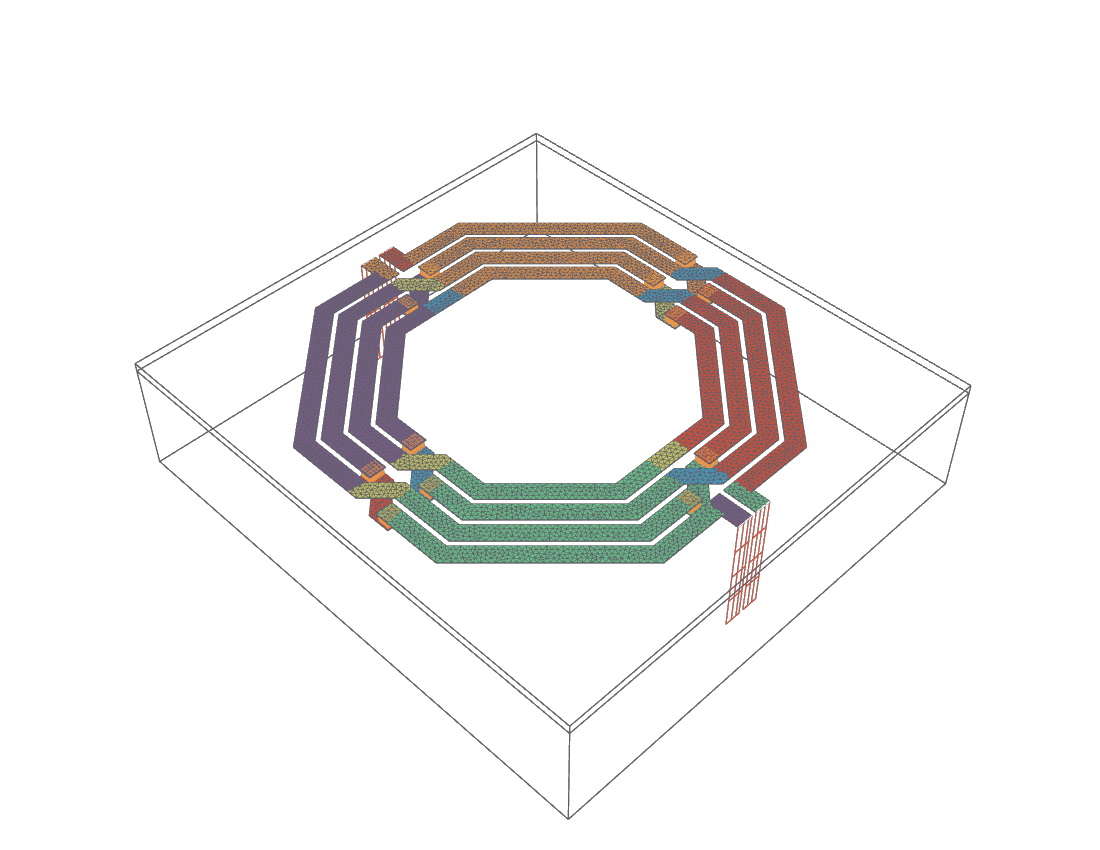
A GMRES residual bounds the algebraic error, but a port observable can be a small difference of large quantities (a quality factor, for instance) or live in a different block of the saddle system entirely. RapidMoM therefore continues the solve down a tolerance ladder, warm-started, until the port-space network itself stops moving, including a dedicated criterion for the real part. Every port configuration lands on the dense-operator answer instead of drifting with the iterative tolerance.
One port primitive
Ports are one primitive: a current driven between two contacts, each an oriented segment on a metal layer, free in position, length and orientation. The excitation is a voltage source across the gap, never an imposed current profile, so the current distribution over the cross-section, edge singularity and skin crowding included, comes out of the solve. A label point resolves at build time to the conductor's terminal edge run; on an outline that runs along a trace rather than ending at one, that resolution is ambiguous and the preflight rejects it instead of guessing.
Two contact kinds and the ground plane give the usual port types out of that one primitive: in-plane cuts, differential gaps whose loop closes locally, vertical probes against the reference, and ports between two conductors on the same or on different layers. All of them are ideal in the same sense, a zero-length lumped source at the contact plane with no feed geometry and no series impedance. The reference plane sits at the metal, so there is nothing to de-embed and the networks compare directly against the port conventions of commercial planar solvers.
Capacitance without the full-wave solve
The A-EFIE saddle carries both potentials: the vector potential in the edge-current block, the scalar potential in the patch-charge block. A capacitance is a statement about the scalar potential alone, so dropping the magnetic half leaves a system in the charges and node potentials that yields the Maxwell C and G matrices over the design's galvanic nets directly, without solving the full-wave problem at all.
Conductor models and outputs
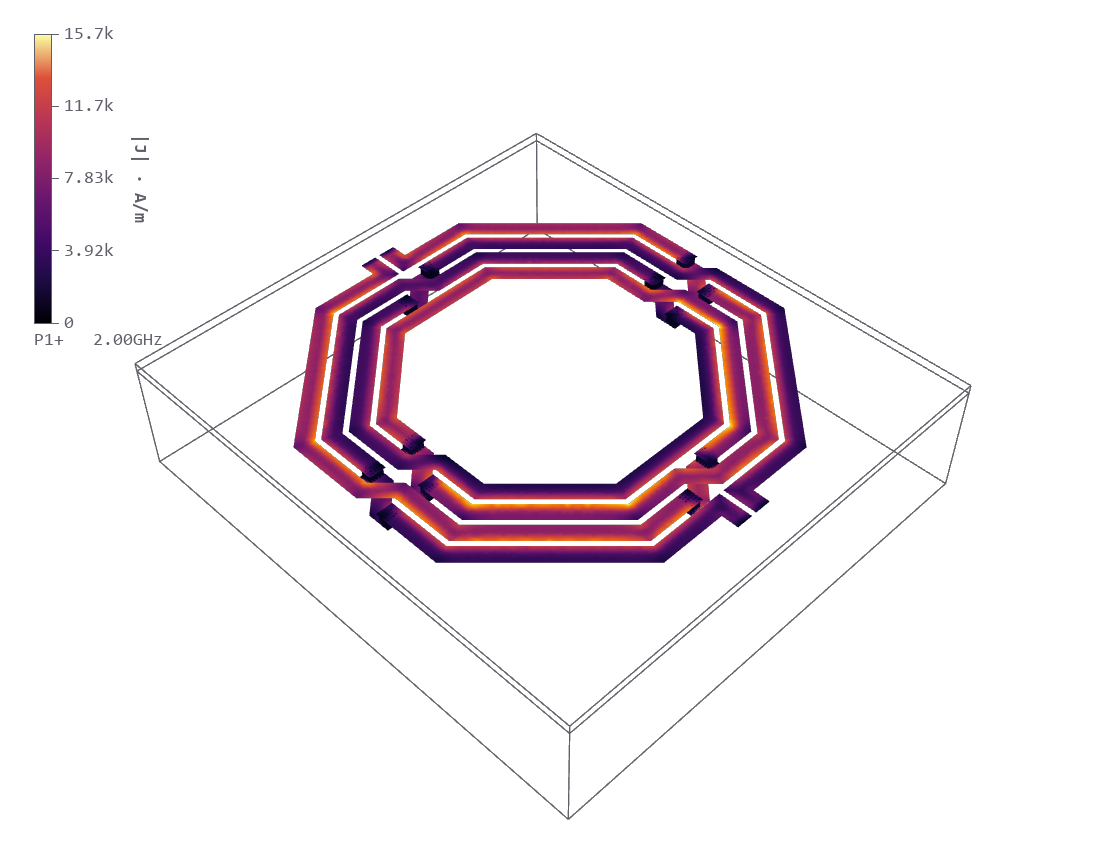
Two production conductor models are available per layer. The sheet model is the classical 2.5D treatment: one RWG current sheet per metal with the two-sided skin-effect surface impedance, the right default for thin metals. The boxed model treats each conductor as a closed thick box with the conductor interior entering through the slab internal-impedance two-port. Output is standard Touchstone (S, Y, Z) plus the device metrics engineers design against: L, Q, coupling.
Validation runs against closed-form analytics, physical invariants (Lorentz reciprocity, mutual-sign checks, skin-effect rise), and an independent reference solver on controlled cases before any device claim is made. The evaluation report is auto-generated from the same pipeline and available on request.
Built for sweeps
Zero-external-dependency pure Rust with a Python API: lightweight, installs in seconds, built for massive cloud parameter sweeps. Solver controls are first-class API (tolerances, warm-started sweeps, feed de-embedding), so embedding needs no environment variables. Broadband S-parameters of an SG13G2 spiral come out of a ROM sweep in about 5 seconds within roughly 600 MB, validated on the real IHP SG13G2 stack.
History
RapidMoM development started in June 2026, in the same push that produced RapidMesh and RSLAB : the planar solver, its mesher, and its linear algebra grew together as one vertically integrated unit. The solver is in early access for evaluation.