RSLAB
A sparse direct solver in pure Rust. PARDISO-style, embeddable, deterministic.
RSLAB is a sparse direct solver for real and complex matrices in pure Rust with no BLAS, LAPACK, or MKL dependency. It is generic over the scalar type, f64, f32 and their complex counterparts, and carries three factorization paths matched to their operator classes: symmetric LDLT with Bunch-Kaufman pivoting, threshold-pivoted unsymmetric LU, and a KLU path for circuit-shaped matrices.
Built for solver-in-the-loop
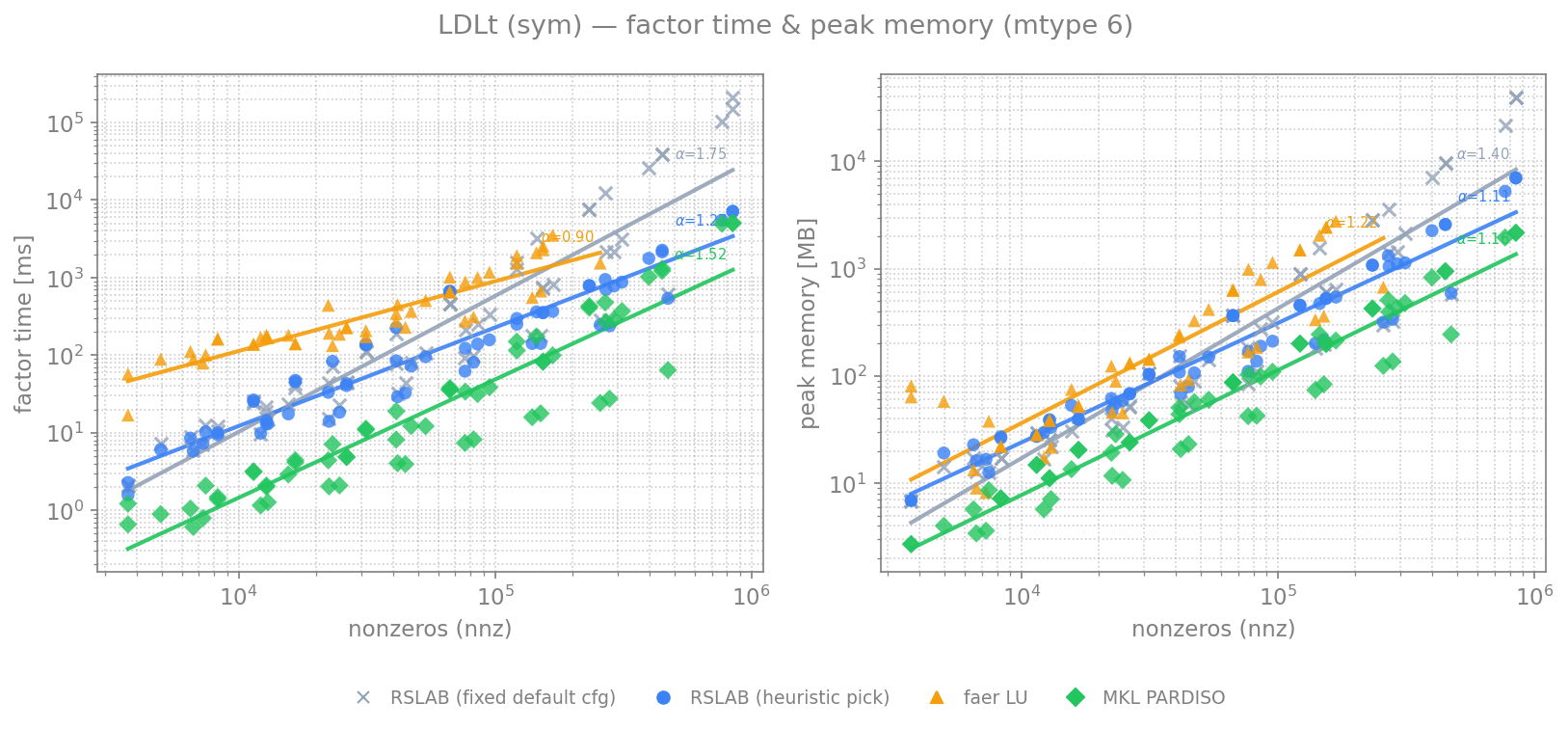
The design target is a solver that sits inside an engine rather than behind a job submission. The numeric factor is bit-identical across thread counts. Peak memory and runtime are predicted exactly from the symbolic structure before any numeric work, which is what makes a sweep schedulable: how many solves fit on a cloud machine, which instance size to rent for them, and whether a given system fits at all, are all answerable before anything is started rather than after a run dies. Fixed-pattern sequences (frequency sweeps, Newton steps) refactor numeric-only on frozen pivots, and solve_transpose reuses the same factors for adjoint and sensitivity solves. Mixed-precision solves factor in single precision, refine against the double-precision original, and return a backward-error certificate. Where a matrix is outside the target class, RSLAB declines rather than returning a degraded solution.
Configuration is a deterministic heuristic: adaptive ordering, an exact nested-dissection bakeoff on large systems, and a worker count from a one-time cached hardware calibration. The solvers never measure implicitly.
The circuit path
Circuit matrices are their own class: unsymmetric, very sparse, and solved thousands of times on a pattern that never changes. A general sparse solver treats every one of those solves as a new problem. The KLU path instead splits the matrix into its block triangular form once, orders and factors the blocks separately, and from then on refactors numerically on the frozen pattern and pivots. Structural singularity falls out of the block analysis before any numeric work happens.
On MNA-shaped matrices that is 2 to 19x faster to factor with 1.7 to 5.7x less fill than the general path, widening with size, and a 20-point sweep runs 6 to 19x faster end to end. The same factors also solve the transposed system, which is what the adjoint sensitivity solves in SANE need.
Benchmarks
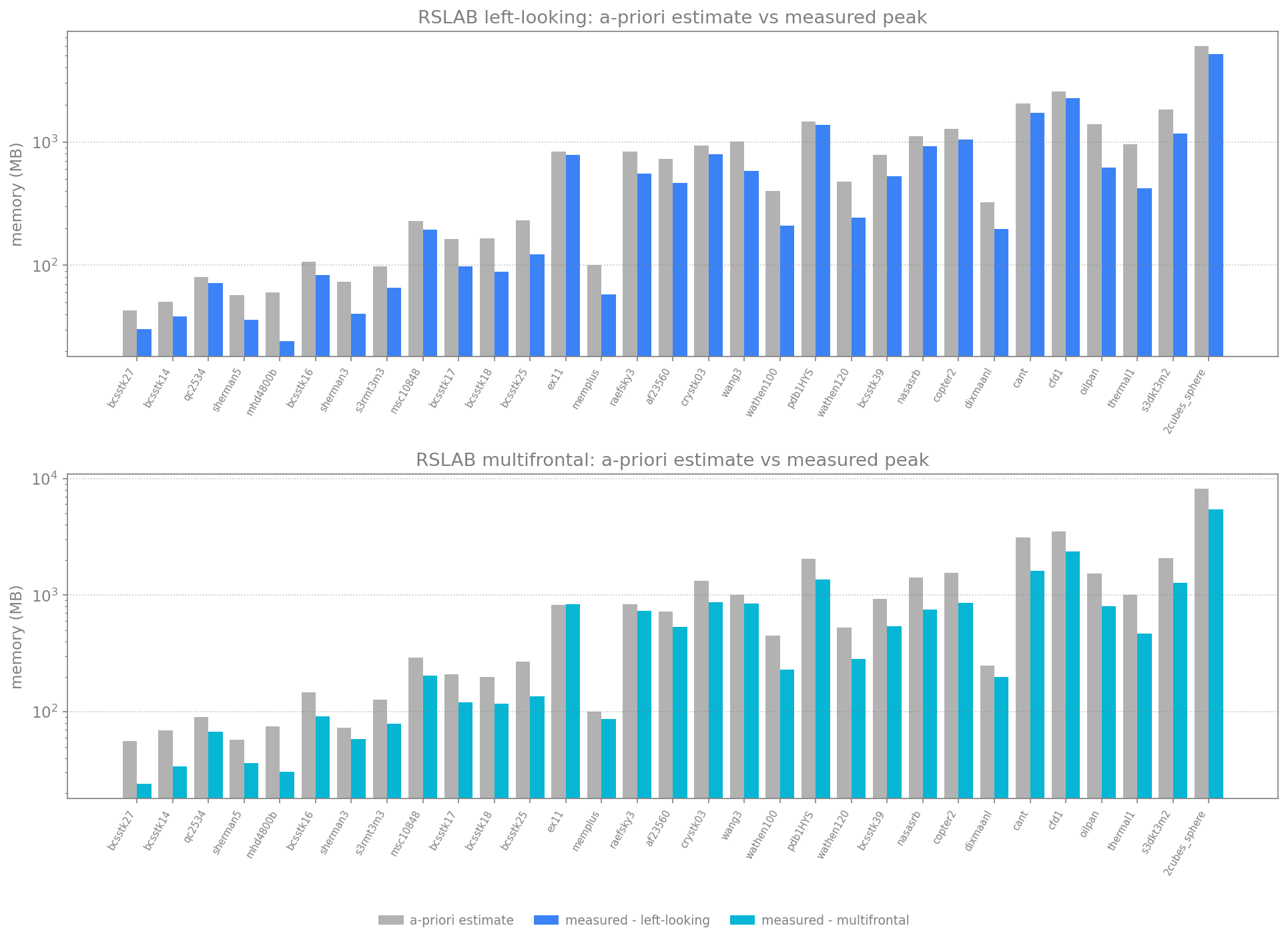
All cross-solver figures come from one benchmark engine over a complete-distribution corpus: structured-grid generators (curl-curl Maxwell, shifted Helmholtz, Stokes/KKT, convection-diffusion, BEM/MoM kernels) plus the complex SuiteSparse matrices, measured in a single run. Geomean over 63 sizes per path: 6.7x faster factor than faer on the symmetric class, 2.7x on the unsymmetric class, within 5.1-5.6x of MKL PARDISO. On the circuit class the KLU path factors 5-12x faster than the general LU, and same-pattern sweeps run 10-40x faster end to end. Accuracy: 24 of 31 complex SuiteSparse matrices below 1e-8 relative residual, matching PARDISO and ahead of faer.
History
I was looking for a sparse direct solver in Rust and found feral, by John Kitchin. After talking with him I forked it, in late June 2026. feral was real-valued only, so the first piece of work was making it generic over the scalar type, without which it is of no use to electromagnetics at all.
After that, development followed the matrices it had to solve. FEM and MoM systems came first, for RapidFEM and RapidMoM ; circuit matrices came later, with SANE , and brought the KLU path with them. The a-priori estimators have the same origin: the sweeps these solvers run are cloud work, and packing and scheduling cloud work means knowing the peak memory of a factorization before paying for the machine that would run it. The symbolic analysis already holds everything needed to answer that.
Along the way I built an MLP cost-model auto-tuner for picking solver configurations and then took it out of the default path: the deterministic heuristic is simpler, reproducible, and holds up. The repository ships a technical report that derives the algorithms and carries the full evaluation; every benchmark reruns with one command.