SANE
Symbolic Analog Network Engine. Symbolic and numeric circuit analysis.
SANE extracts the differential-algebraic system F(x, x', t) = 0 from a circuit and analyzes it symbolically and numerically: DC operating point, transient, small-signal AC, poles/zeros, noise, harmonic balance, and exact first- and second-order parameter sensitivities for each of those, all by automatic differentiation of one hash-consed symbolic DAG.
import numpy as np
import sane

model = sane.Circuit.parse("""
    V1 in 0 5
    R1 in out 1k
    C1 out 0 1u
""").extract()

op   = model.operating_point()          # DC bias, labeled by node
ss   = model.small_signal("V1", "out")  # linearize at the bias
ss.poles()                              # [-1000.+0.j], the RC pole
traj = model.transient(np.linspace(0, 5e-3, 200))
sens = op.sensitivity("out")            # exact dy/dp, one adjoint solve
sens.ranked()                           # parameters by relative sensitivity
Results are labeled by node and parameter name, not positional vectors. A result object keeps its solved state, so derived analyses need no re-solve, and parameters read and write hierarchically: model.X1.R2 = 1e3.
Frontends and devices
The SPICE frontend parses .param expressions, .subckt hierarchy, .model cards, and the standard source waveforms (SIN, PULSE, EXP, PWL). Devices cover the classic set: diodes, MOSFETs, BJTs (Gummel-Poon), JFETs, MESFETs, controlled sources and switches, behavioral sources, and transmission lines. The web app at sane.milanrother.com runs the full engine in the browser.
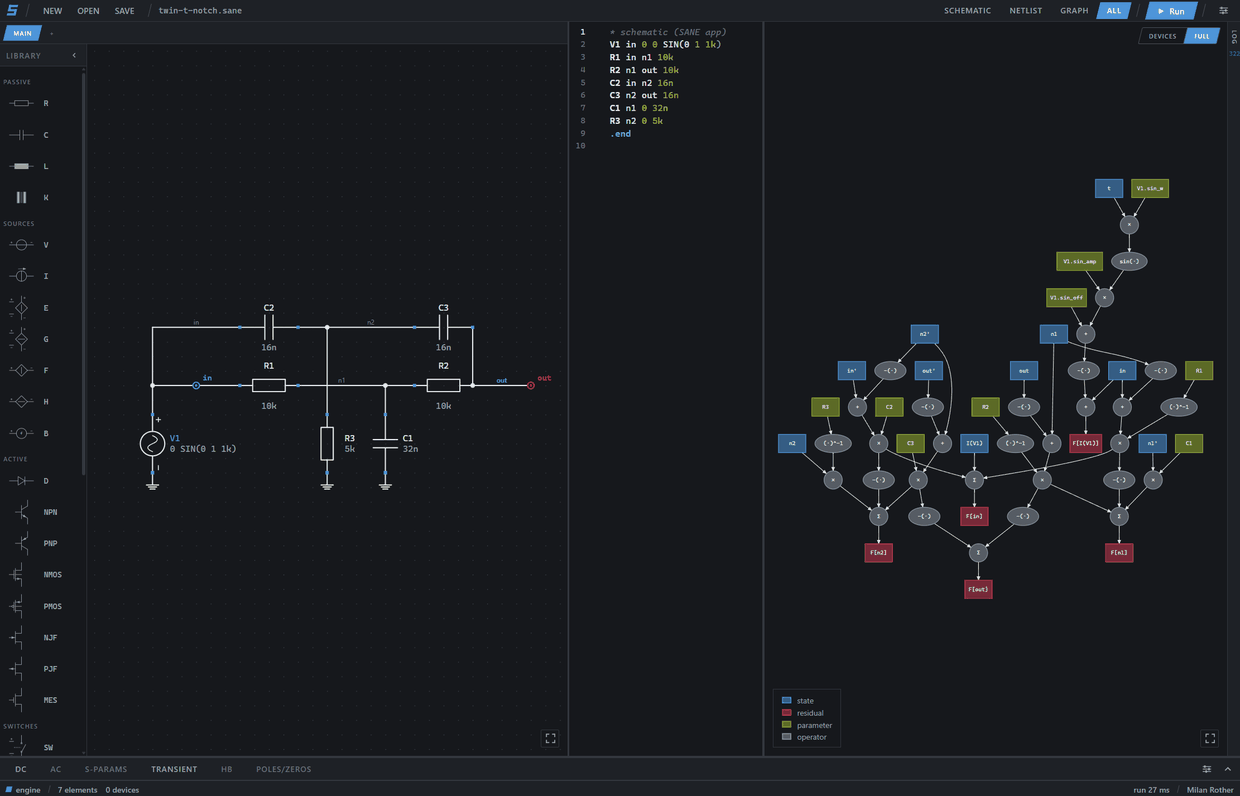
Schematic, netlist and the graph the engine actually solves are three views of one circuit, live next to each other. Here a twin-T notch filter: seven elements, small enough that the whole DAG fits on screen next to the drawing it came from.
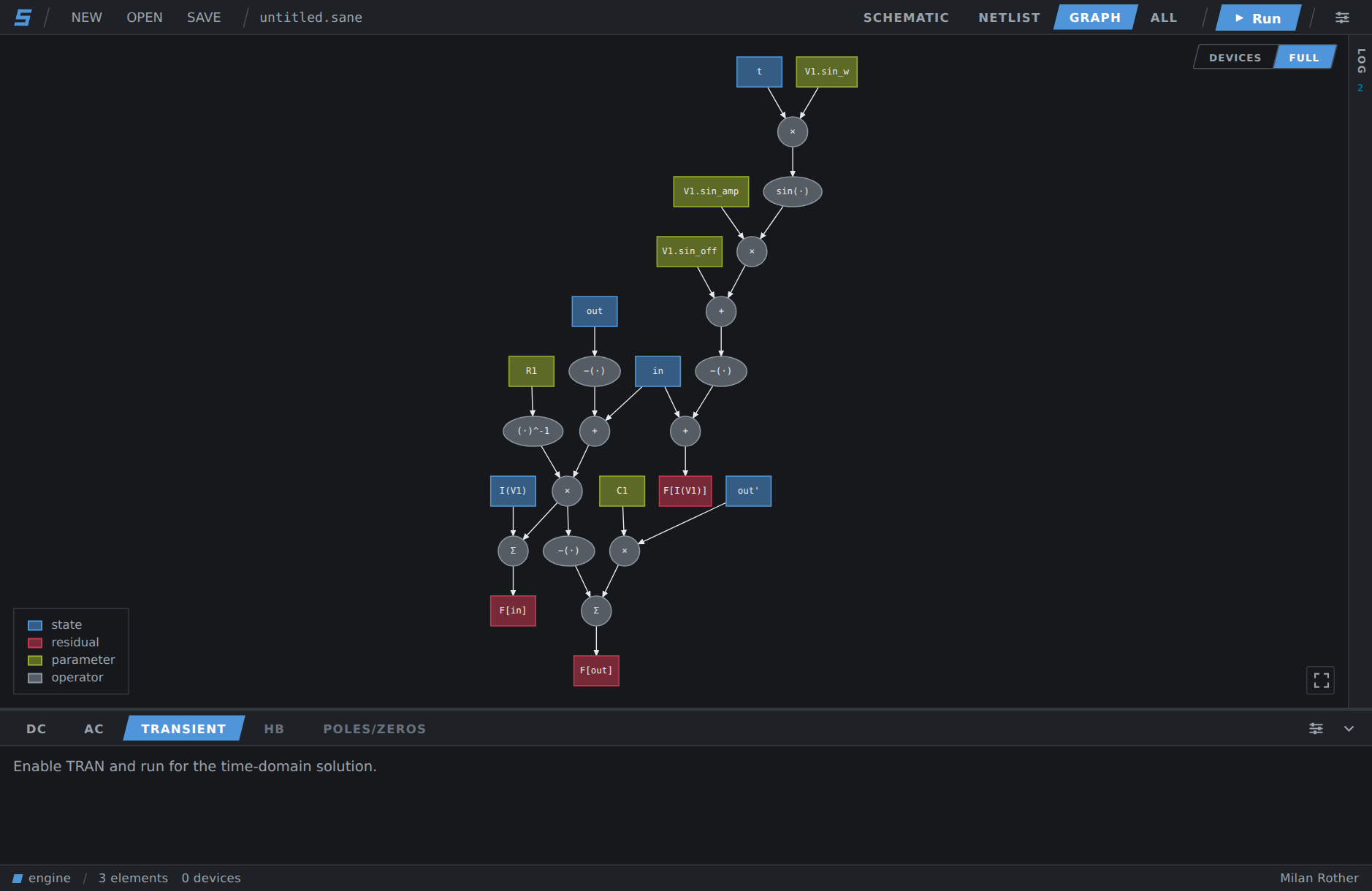
Compact models go the same way. The usual route into a simulator is an OSDI binary compiled from the Verilog-A source, which is fast but opaque to everything upstream of it. SANE instead lowers the Verilog-A onto the same DAG, with no OSDI binary and no generated code. This costs some extra work at model load, but in return every model parameter stays exposed to the autodiff, even in harmonic balance. Temperature is a first-class symbolic global, so .temp sweeps are physical and d(metric)/dT is exact. Noise sources (thermal, shot, flicker, Verilog-A noise) are summed in one registry.
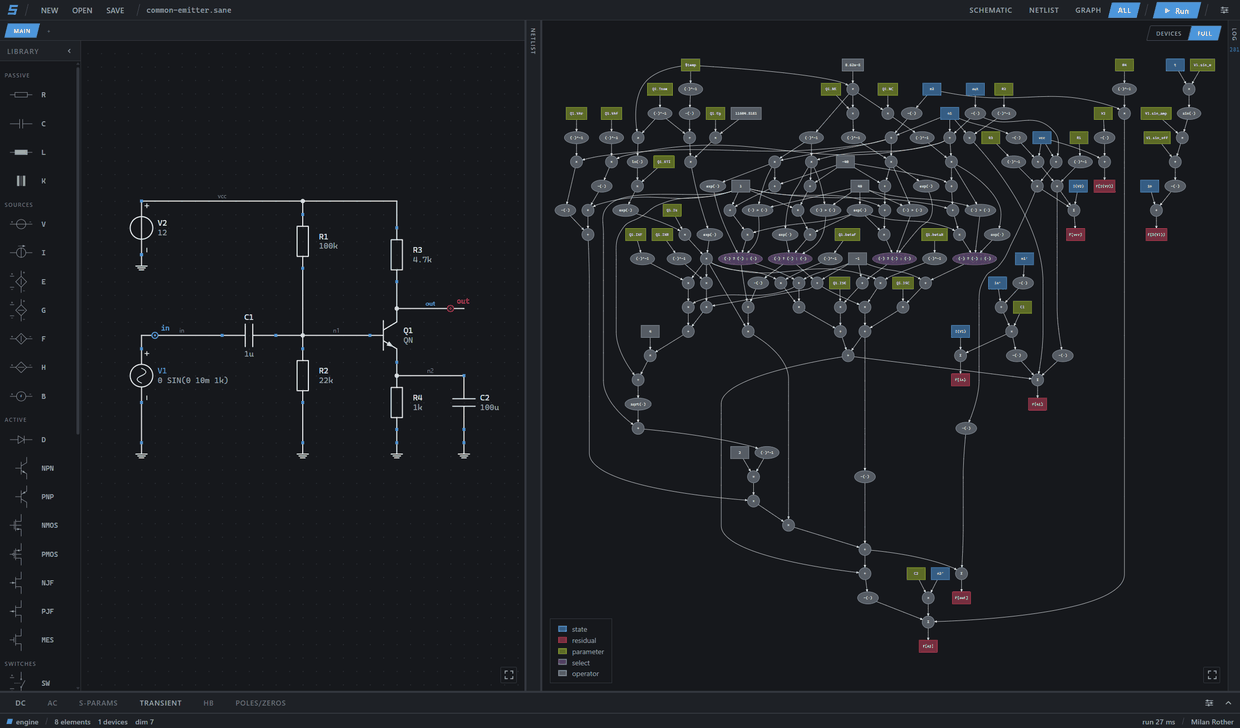
A common-emitter stage is one transistor and seven passives, and the Gummel-Poon model of that single BJT is most of the graph shown here. Every node in it is differentiable, and every parameter of the compact model is still a symbol the sensitivity analysis can reach.
The engine
Rust core: hash-consed symbolic DAG, autodiff, threaded sparse LU (via RSLAB ), optional Cranelift JIT. Python binding via PyO3, or embed the whole engine in Rust with no Python at all.
Validation
Every claim is checked against independent references on real circuits: more than sixty decks spanning RC networks, textbook transistor stages, the uA741, production SKY130 AnalogGym operational amplifiers, and IBM power grids past 100k nodes. DC operating points agree with ngspice within a millivolt across the corpus, harmonic balance is checked against Xyce, and the symbolic transfer functions against Lcapy. Cold DC solves run in 0.015 to 2.5 ms at the raw engine call.
History
SANE is the return to my RFIC EDA roots, and the third time I have written this tool. The first was MiCir in 2019, a symbolic network analysis library built on nothing but Python's math module: my own matrix class, my own complex arithmetic, symbolic element types in s, netlists in and Cauer ladders out. The second was the exact parameter sensitivities in my master's thesis, where the first and second partial derivatives of RLCk transfer functions are read analytically off the block structure of the MNA matrices. The autodiff over the DAG is the general version of that.
It also builds on work I did together with Ralf Sommer, the inventor of Analog Insydes, on reviving that tool from December 2024 on.
The direct trigger came from the other end of the stack: FastSim had just been built on SSA compute graphs, Python callbacks traced into a flat tape and differentiated symbolically, and carrying that representation over to circuits looked like the obvious next step, with Analog Insydes in the back of my mind throughout. Matt Keeter's writing on SSA graphs for implicit surfaces was the other half of the push: the same representation, an entirely different field.
In June 2026 I picked the ideas up on my own stack. The first two months produced the SPICE parser, the symbolic DAG engine, the full set of analyses, and the Verilog-A frontend. The web app at sane.milanrother.com is public; the core engine is in early access.