FastSim
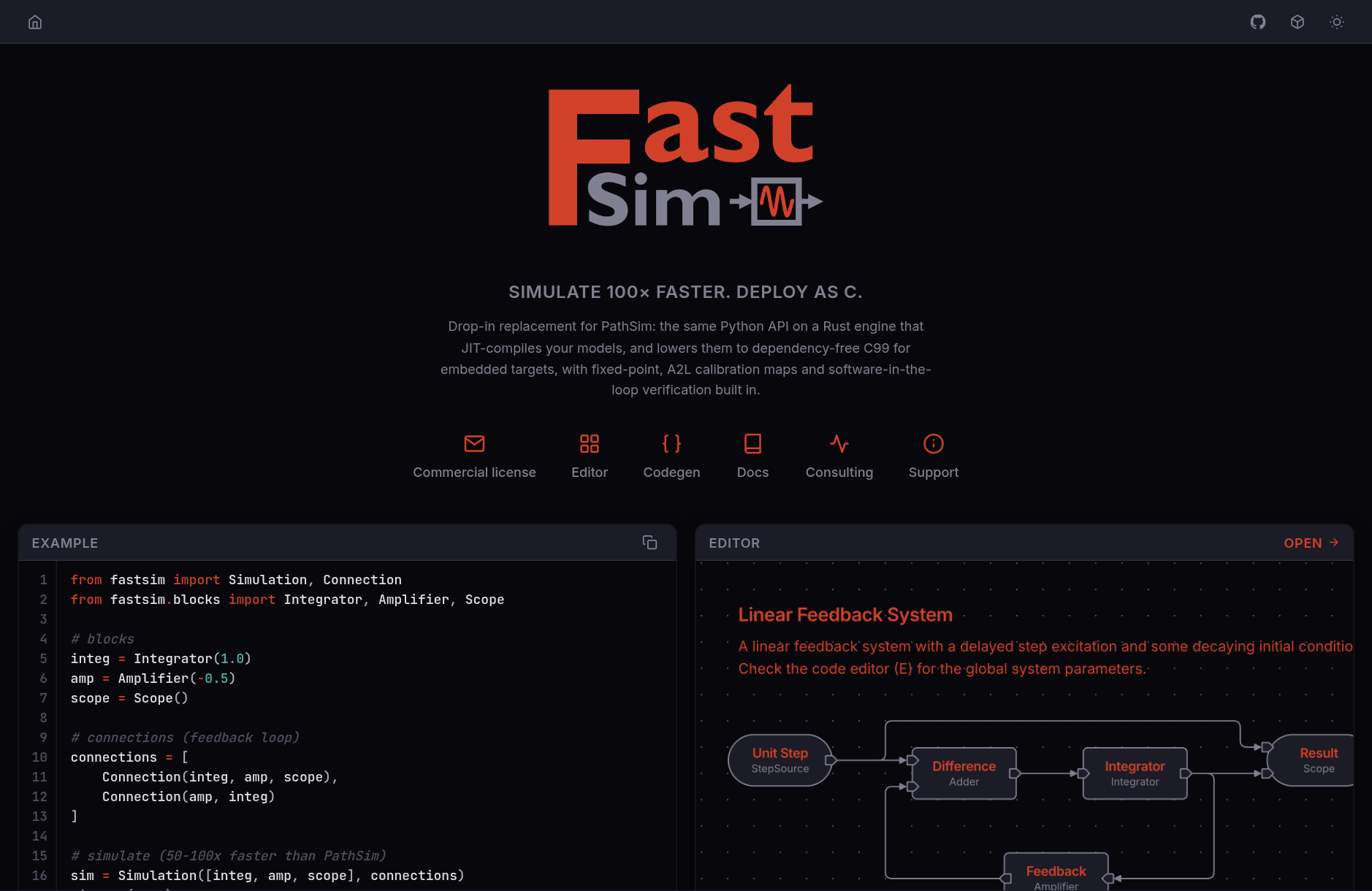
The drop-in Rust engine for PathSim. Swap the import and go.
FastSim is a Rust reimplementation of PathSim with an identical Python API. Across a 55-system benchmark catalog the median measured per-step speedup over PathSim is 191x, and your existing model gets it by changing one line:
# drop-in: swap the import and your PathSim model runs in Rust
# from pathsim import Simulation, Connection
from fastsim import Simulation, Connection

# all 21 solvers also work standalone, with automatic JIT
from fastsim.solvers import RKDP54, ESDIRK43

def lorenz(x, t):
    sigma, rho, beta = 10.0, 28.0, 8.0/3.0
    return [sigma*(x[1]-x[0]), x[0]*(rho-x[2])-x[1], x[0]*x[1]-beta*x[2]]

t, x = RKDP54.integrate(lorenz, [1, 1, 1], time_end=50.0)

# implicit solver for stiff systems, Jacobian generated via AD
t, x = ESDIRK43.integrate(robertson, [1, 0, 0], time_end=1.0)

# JIT and autodiff exposed as JAX-style transformations
from fastsim.jit import jit, jacobian

f = jit(lorenz)                              # traced to SSA, run in Rust
J = jacobian(lorenz)([1.0, 1.0, 1.0], 0.0)   # exact 3x3 Jacobian
Python callbacks are automatically traced into an optimized SSA graph, symbolically differentiated, and evaluated in Rust. No code generation step, no toolchain on the user's machine, no model rewrite. Supported operations cover arithmetic, numpy transcendentals, dot products, matrix multiply, clipping, branching, and more; unsupported patterns fall back to Python.
The engine
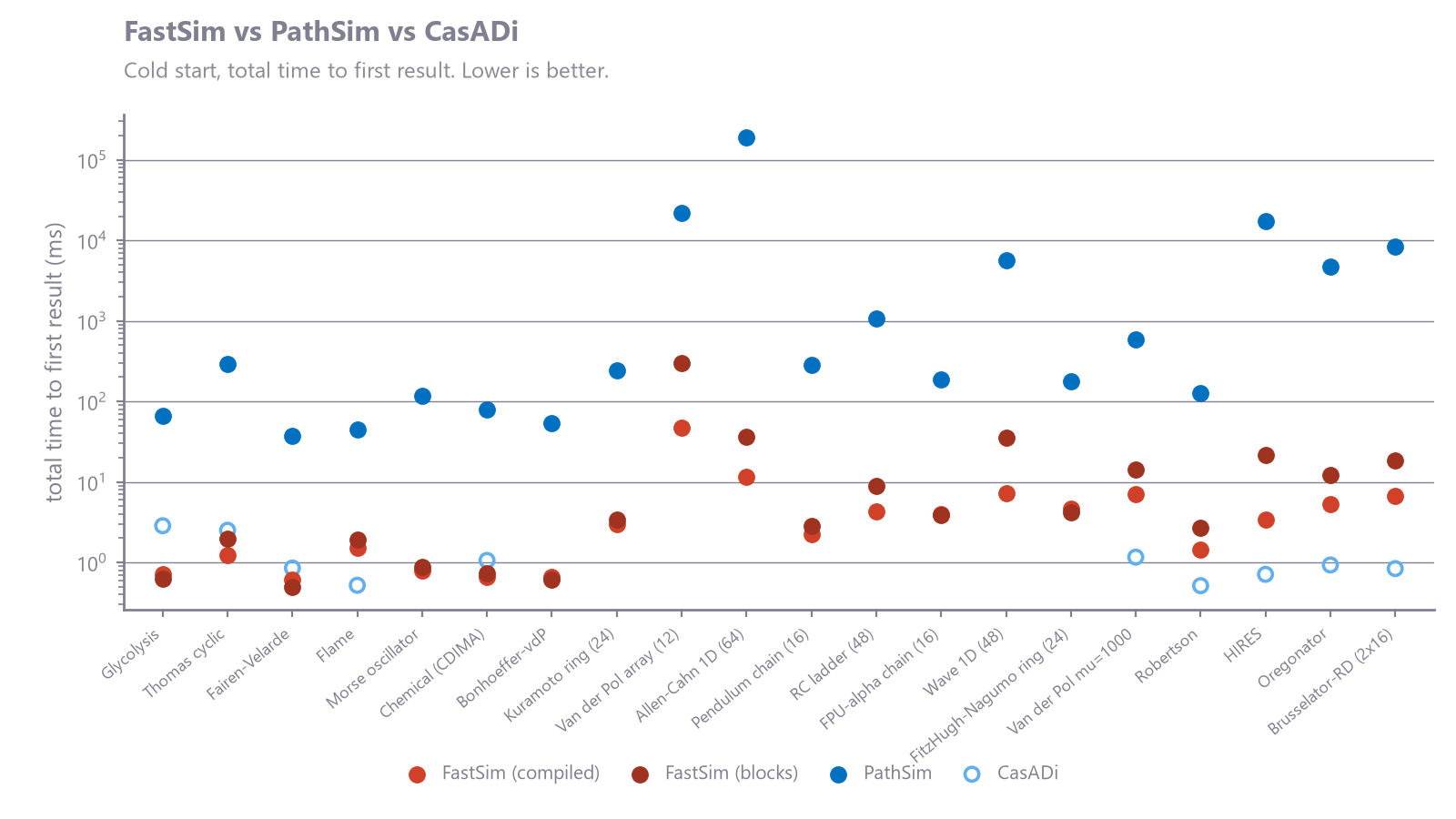
The trace-to-SSA compiler turns Python callbacks into a flat-tape IR with common subexpression elimination, constant folding, strength reduction, and FMA detection. Symbolic forward-mode automatic differentiation supplies analytical Jacobians to the twenty-one explicit and implicit integrators, which include a preconditioned-Anderson implicit solve, periodic steady state, and collocation boundary-value problems. Underneath: zero-copy data paths, flat DAG evaluation, dynamic block sizing.
The compiler is also useful on its own. Solvers run standalone with automatic JIT, RKDP54.integrate(func, x0, time_end=50), and jit(func) and jacobian(func) are exposed as JAX-style transformations. Event handling, hierarchical subsystems, and mutable parameters work exactly like PathSim.
Export targets
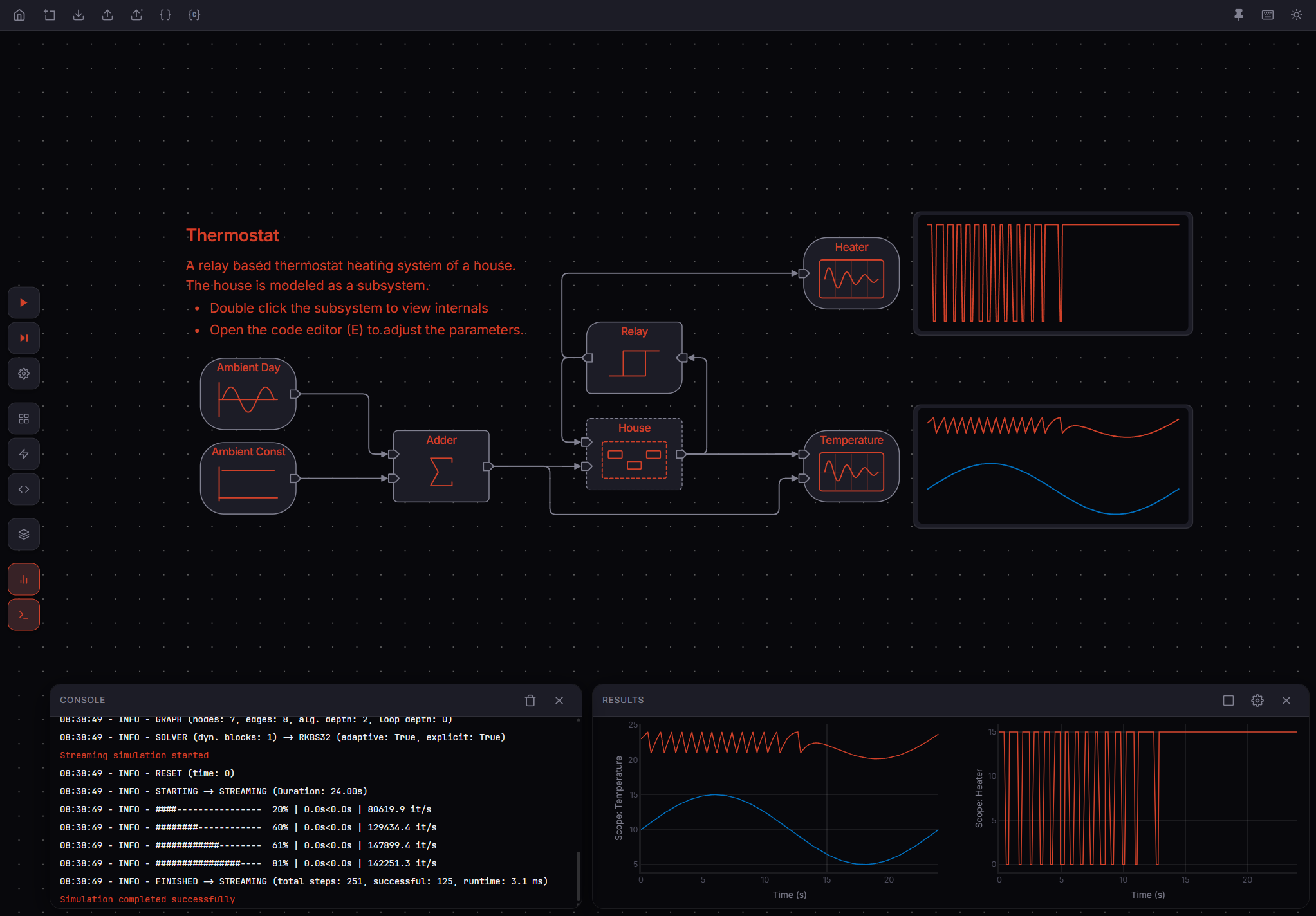
All export targets lower from the same SSA graph, operation by operation: FMI 3.0 import and export (model exchange and co-simulation, events included), WebAssembly, and dependency-free C99 for embedded targets. Interpreted mode, compiled mode and the exported artifacts all run the same op-level IR, structure-preserving throughout, so the outputs stay verifiable and qualifiable. WebAssembly is a clean build target, which is how FastSim runs inside PathView under Pyodide: the same drop-in swap of the import, in a browser tab.
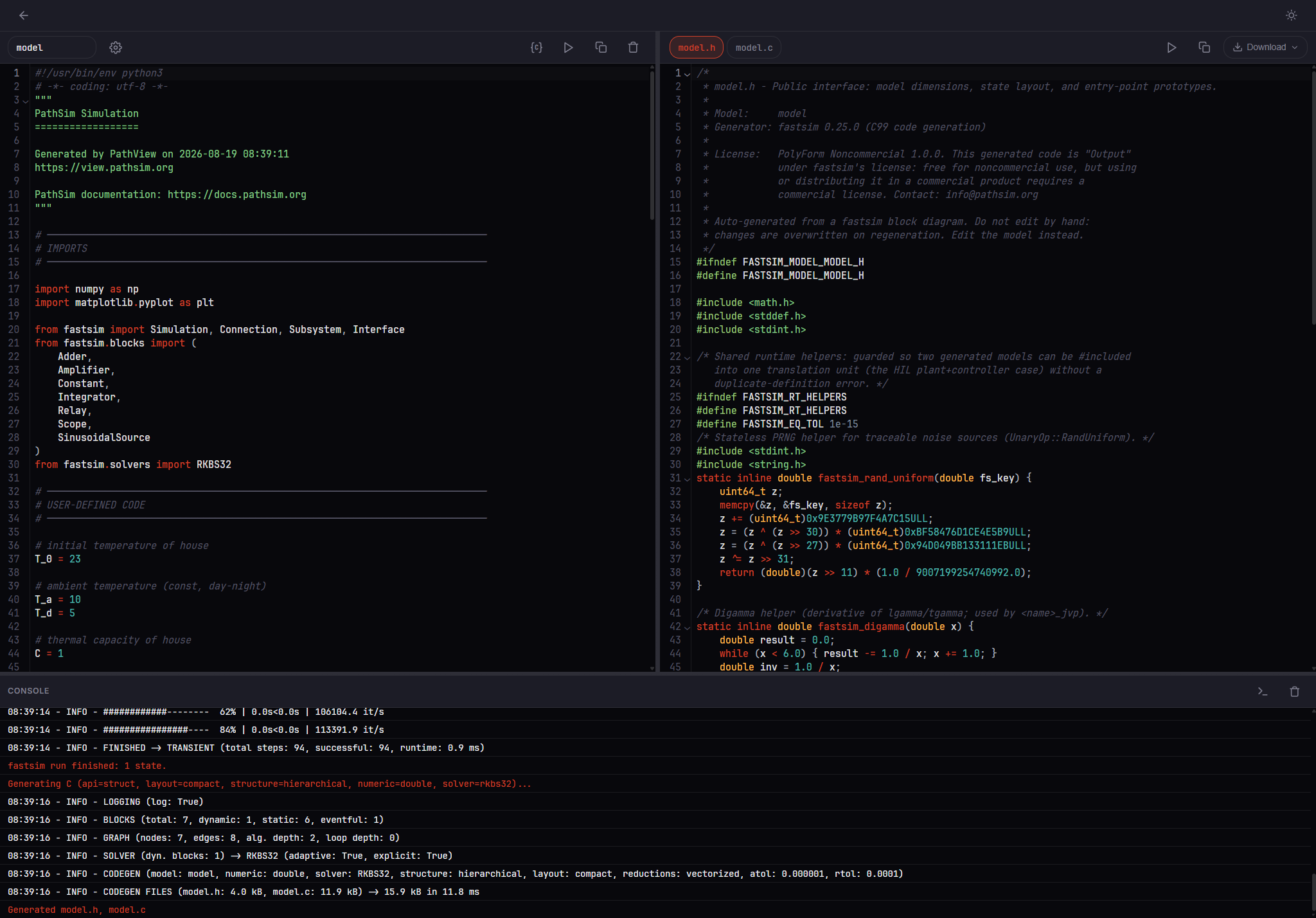
Code generation has its own UI and several output shapes: a single file or a library, unrolled or vectorized, with numeric type, solver, structure and API layout as further switches. A seven-block model comes out at 15.9 kB in 12 ms. The generated C is verified software-in-the-loop: sim.verify_c() compiles it locally and pins it against the reference engine, sample by sample.
Validation
A benchmark suite reruns each study with one command. Fixed-order integrators are checked against their theoretical convergence orders, accuracy is measured against reference solutions, and the comparisons cover SciPy, CasADi, and DifferentialEquations.jl. A technical report that states the theory and the implementation together is available on request.
History
FastSim development started in April 2026, after the PathSim API had stabilized. Four months of development produced the engine, JIT, autodiff, FMI export, and C code generation, tracking the PathSim API throughout. The SSA compute graphs built here are the ones SANE later carried over to circuits. Commercial licensing funds the open system level.