PathSim
Open-source system simulation in pure Python.
PathSim is a pure-Python framework for modeling and simulating dynamical systems. Connect sources, integrators, functions, and scopes to build continuous-time, discrete-time, or hybrid systems as block diagrams. Built from first principles with custom solvers, an event system, and a modular block API. Minimal dependencies: numpy, scipy, matplotlib.
from pathsim import Simulation, Connection
from pathsim.blocks import Integrator, Amplifier, Adder, Scope

# damped harmonic oscillator: x'' + 0.5x' + 2x = 0
int_v = Integrator(5)       # velocity, v0=5
int_x = Integrator(2)       # position, x0=2
amp_c = Amplifier(-0.5)     # damping
amp_k = Amplifier(-2)       # spring
add, scp = Adder(), Scope()

sim = Simulation(
    blocks=[int_v, int_x, amp_c, amp_k, add, scp],
    connections=[
        Connection(int_v, int_x, amp_c),
        Connection(int_x, amp_k, scp),
        Connection(amp_c, add),
        Connection(amp_k, add[1]),
        Connection(add, int_v),
    ],
    dt=0.05,
)
sim.run(30)
scp.plot()
Solvers and events
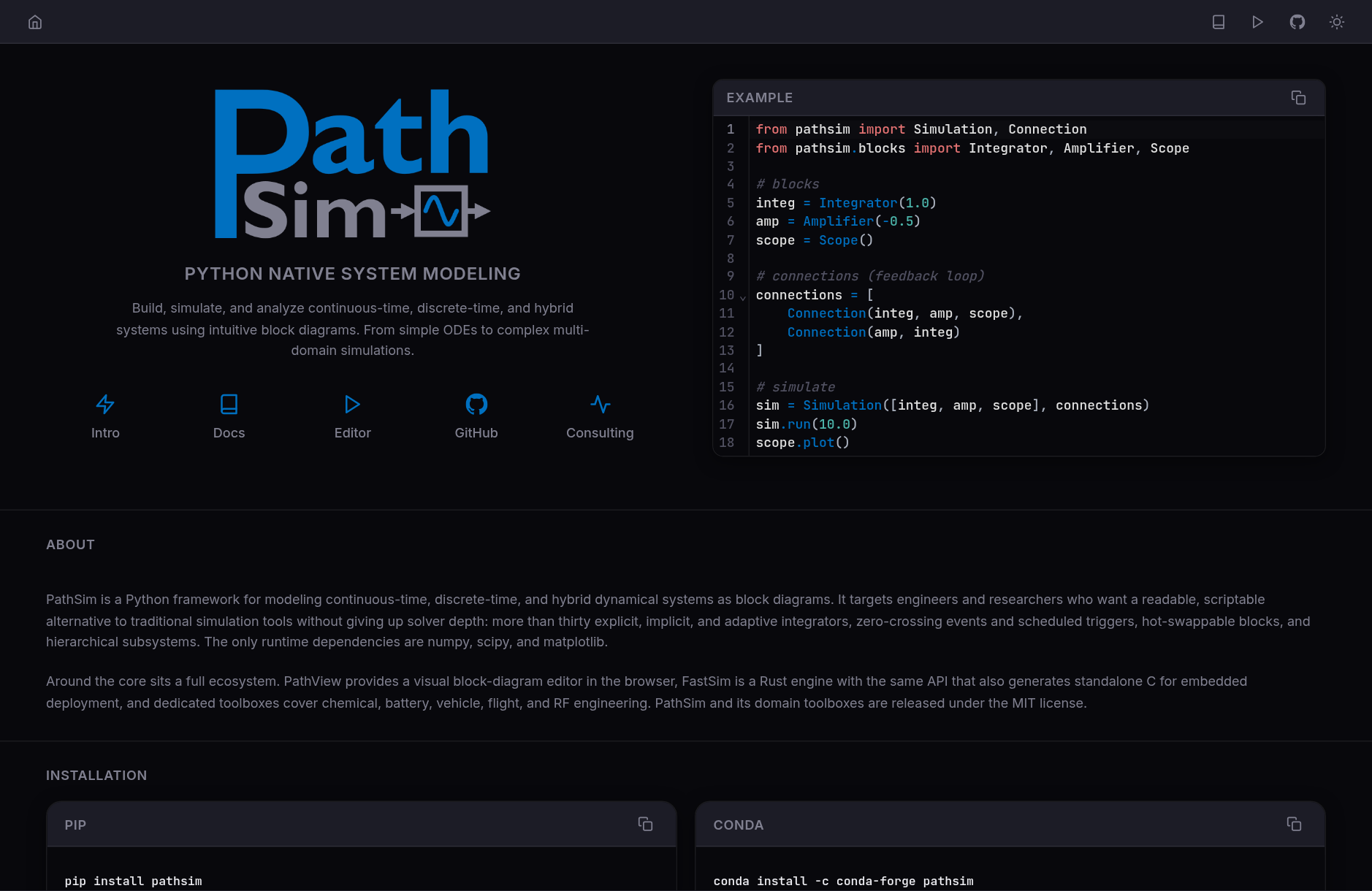
PathSim is hot-swappable: blocks, parameters, and solvers can be modified during a running simulation. The solver suite spans more than thirty explicit and implicit integrators, adaptive and fixed-step, including stiff methods like BDF and ESDIRK. Hybrid systems are first-class: zero-crossing detection, scheduled events, and conditions put discrete events right next to continuous dynamics. Subsystems nest hierarchically, algebraic loops are handled robustly, and custom components are plain Python subclasses of Block.
PathSim is published in JOSS, adopted by JSBSim for flight dynamics, and used at the MIT Plasma Science and Fusion Center for nuclear fusion fuel-cycle modeling. Domain toolboxes cover chemical engineering, batteries, vehicles, flight dynamics, RF, and FMI co-simulation, several of them community-contributed.
Install with pip install pathsim or conda install conda-forge::pathsim. The documentation at docs.pathsim.org has tutorials, end-to-end examples, and the full API reference.
In fusion research
The MIT Plasma Science and Fusion Center and the UK Atomic Energy Authority use PathSim as the orchestrating framework for tritium fuel cycle modelling. The published workflow puts three fidelities in one timestepping loop: a zero-dimensional residence time model of an ARC-class power plant, an intermediate one-dimensional model of a liquid metal bubble column validated against the literature, and high-fidelity multi-dimensional transport in the finite element code FESTIM, wrapped as ordinary blocks. The same system model scales down to lab experiments like BABY and LIBRA.
A component's fidelity is a property of the block, not of the framework, so a residence-time approximation can be swapped for a finite element solve without touching the system around it. A thirty-component bubbler transient solves in seconds, fast enough for Monte Carlo and uncertainty quantification runs.
The workflow is written up in Physics-informed tritium fuel cycle modelling workflow for fusion reactors ( arXiv:2603.25751 ), which I co-authored, and I presented PathSim at the IAEA workshop on digital engineering for fusion energy research in December 2025.
History
PathSim started in early 2023, at the beginning of my PhD, as an analog computer emulator side project. There was no repository at first, just a zip archive: 31 snapshots between December 2023 and August 2024.
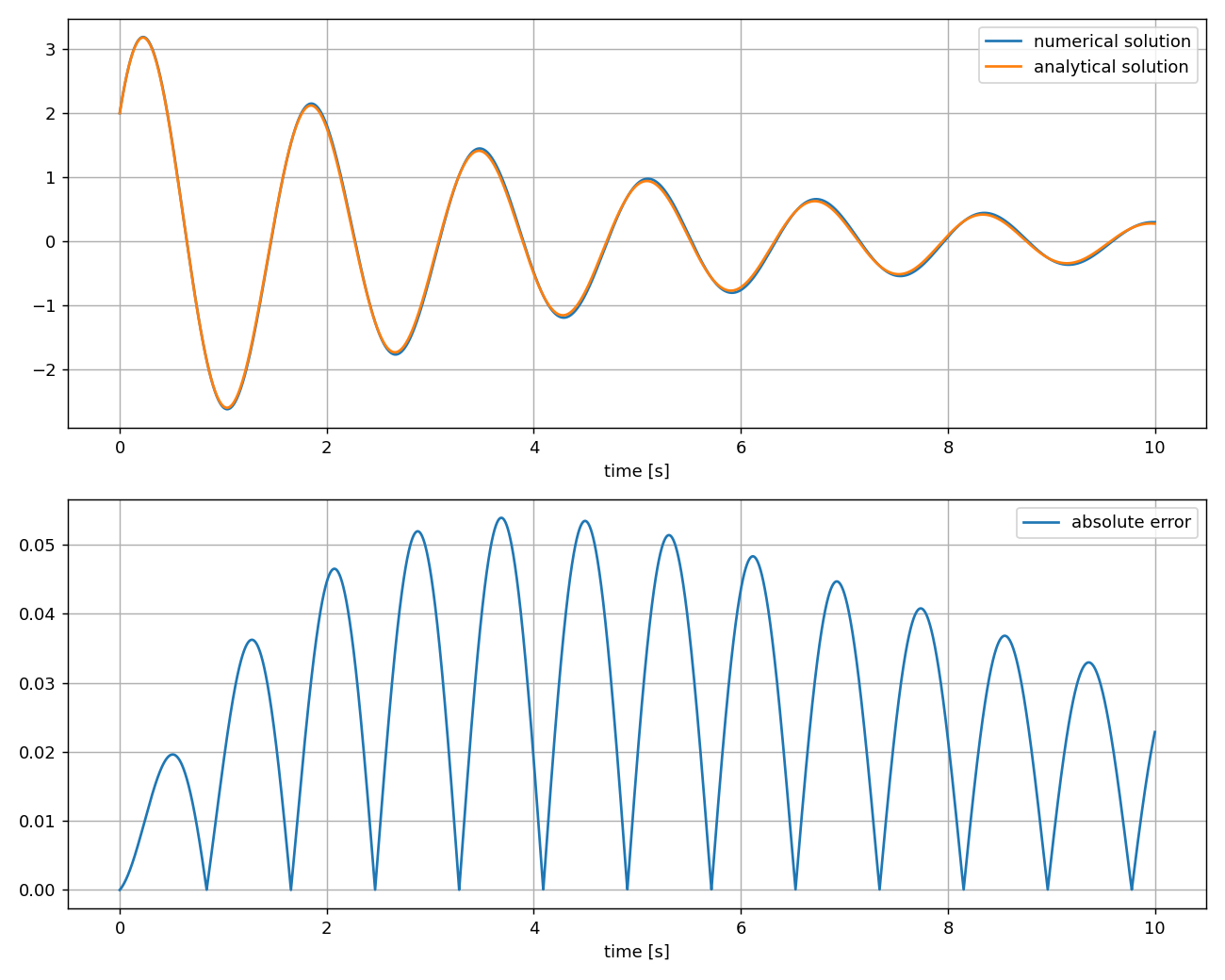
The earliest snapshot is from December 17, 2023. It already contains Simulation, Connection, Integrator, Amplifier, Adder and Scope, the same names the API uses today. The test cases back then: a damped harmonic oscillator checked against the analytical solution, a slip-stick system with Coulomb friction, and a radar system in a notebook. The figure shows the December 2023 engine running its harmonic oscillator test, executed today.
The last zip is from August 11, 2024, the same day as the first commit on GitHub. In March 2025 I announced PathSim as an open alternative to Simulink.
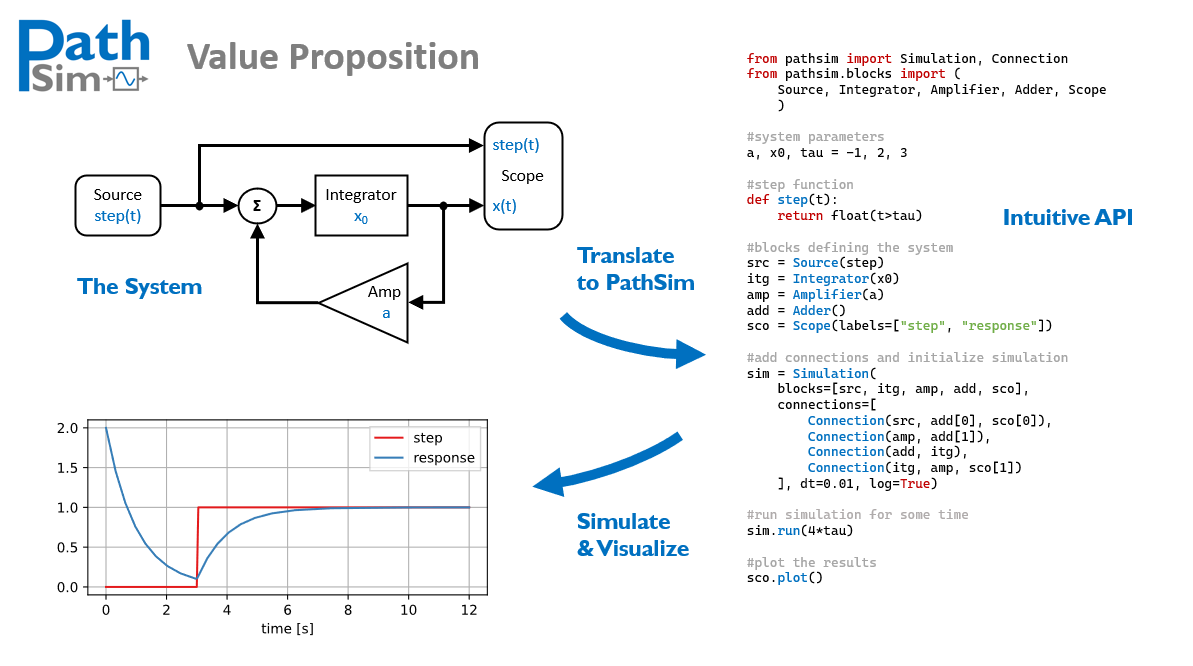
The original pitch slide from spring 2025: block diagram on the left, the same system in the API on the right, and the simulated response below.
Since then: a JOSS publication, roughly 400 GitHub stars, nine contributors, adoption by JSBSim and the MIT Plasma Science and Fusion Center, and community-contributed domain toolboxes. FastSim accelerates the same API as a drop-in Rust engine, and PathView edits PathSim models visually in the browser.