falllow
A distributed compute pool. Tests and builds on machines that are otherwise idle.
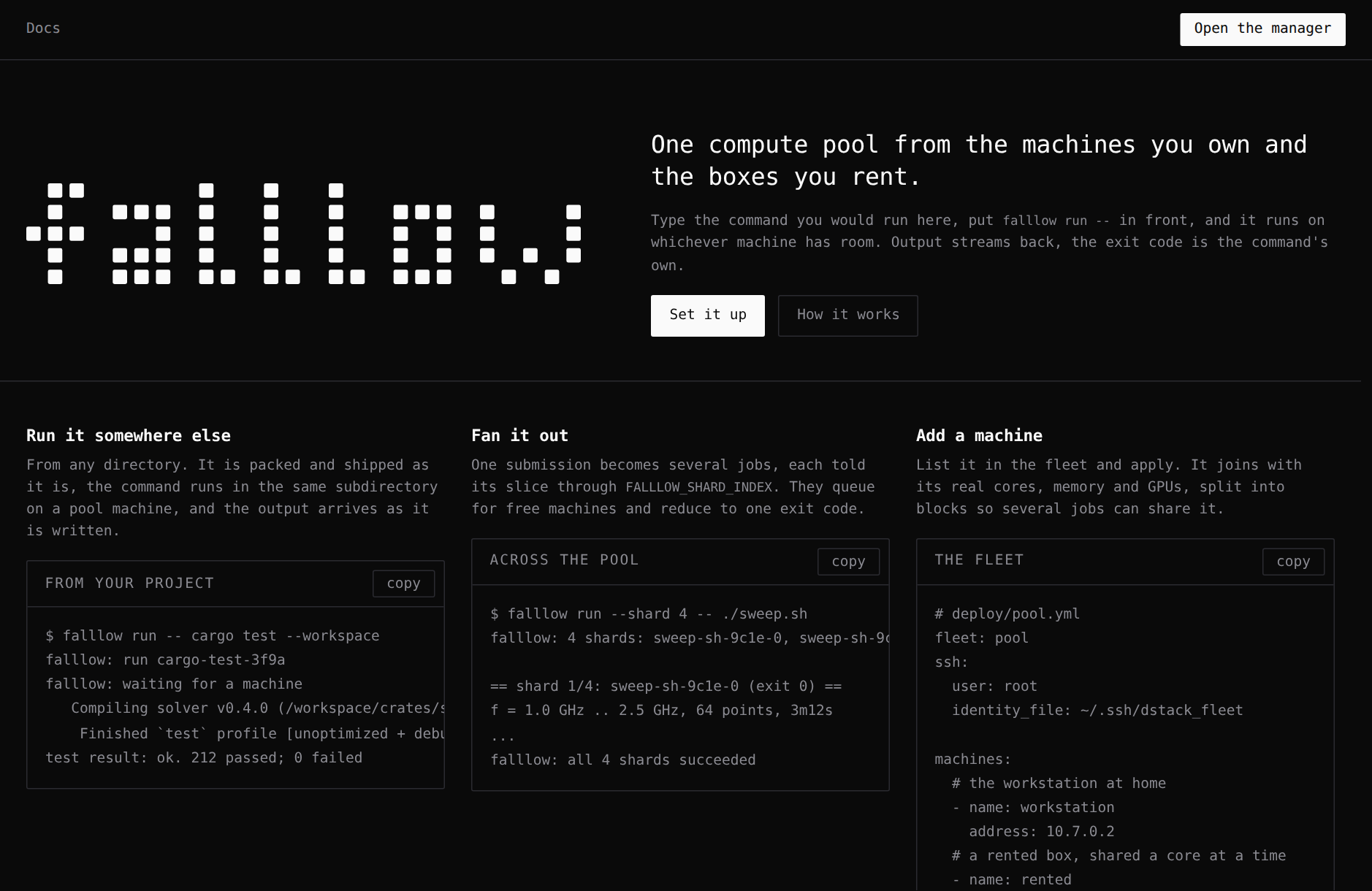
falllow is a distributed compute pool. A machine enrols once and then takes jobs; a job is a command submitted from a working directory, run on whichever machine is free, and returned with its own output and its own exit code.
How it works
Runners dial the control plane and hold a websocket open, so a desktop behind a home router joins the pool the same way a rented server does. Jobs run in containers on a fresh tree hard-linked from a content-addressed store, with threads and memory reserved by cgroups on Linux and job objects on Windows, inside a budget the machine's owner sets. One submission can shard across several machines and reduce to a single exit code, and that code is the command's own: 170 is reserved for falllow's own failures, and only those are retried. A queued GitHub Actions job can take an ephemeral runner from the pool.
A CLI, a headless runner daemon, the control plane and a desktop app that ships the daemon with it. Rust with axum and Postgres behind Caddy on one VPS; the interfaces are SvelteKit, the desktop app Tauri.
History
falllow came out of the validation runs for RapidFEM and RapidMoM : many medium-sized jobs, none of them large, all of them long. They occupied the machine I was working on for hours at a time.
That kind of load does not need current hardware, just a lot of ordinary cores. Old gaming machines and desktops idle through most of the day and are already paid for, so that is where the cores come from.
A few practical constraints shaped the rest. Away from the desk the same runs drain the laptop battery, and the machines at home sit behind a router, which is why runners dial out rather than listen. Coding agents can offload test suites to the pool instead of blocking the machine they run on. And CI runs are billed in Actions minutes, which is what the GitHub bridge is for.