nanospice
A classic SPICE circuit simulator in one Rust file, capped at 1000 lines of code.
nanospice is a classic SPICE circuit simulator in one Rust source file, capped at 1000 lines of code by a test that counts the file and fails the build above it. Four analyses fit under the cap: operating point, DC sweep, transient with an adaptive timestep, and AC. Modified nodal analysis with branch currents for voltage sources and inductors, Newton-Raphson with pnjlim junction limiting, gmin stepping and source stepping as operating point fallbacks, trapezoidal companion models with LTE timestep control, and a sparse LU generic over real and complex scalars.
Two primitives carry every device
Every device stamp goes through two Verilog-A style contribution primitives, one for currents and one for voltage-defined branches. That is what leaves eleven device types inside the budget: diodes, level 1 MOSFETs, JFETs, Ebers-Moll BJTs, the passives, independent sources with sine, pulse and piecewise linear waveforms, and voltage and current controlled sources. Junction capacitances desugar in the parser into internal graded capacitors, so no device model carries charge storage of its own and the AC path sees them as capacitors.
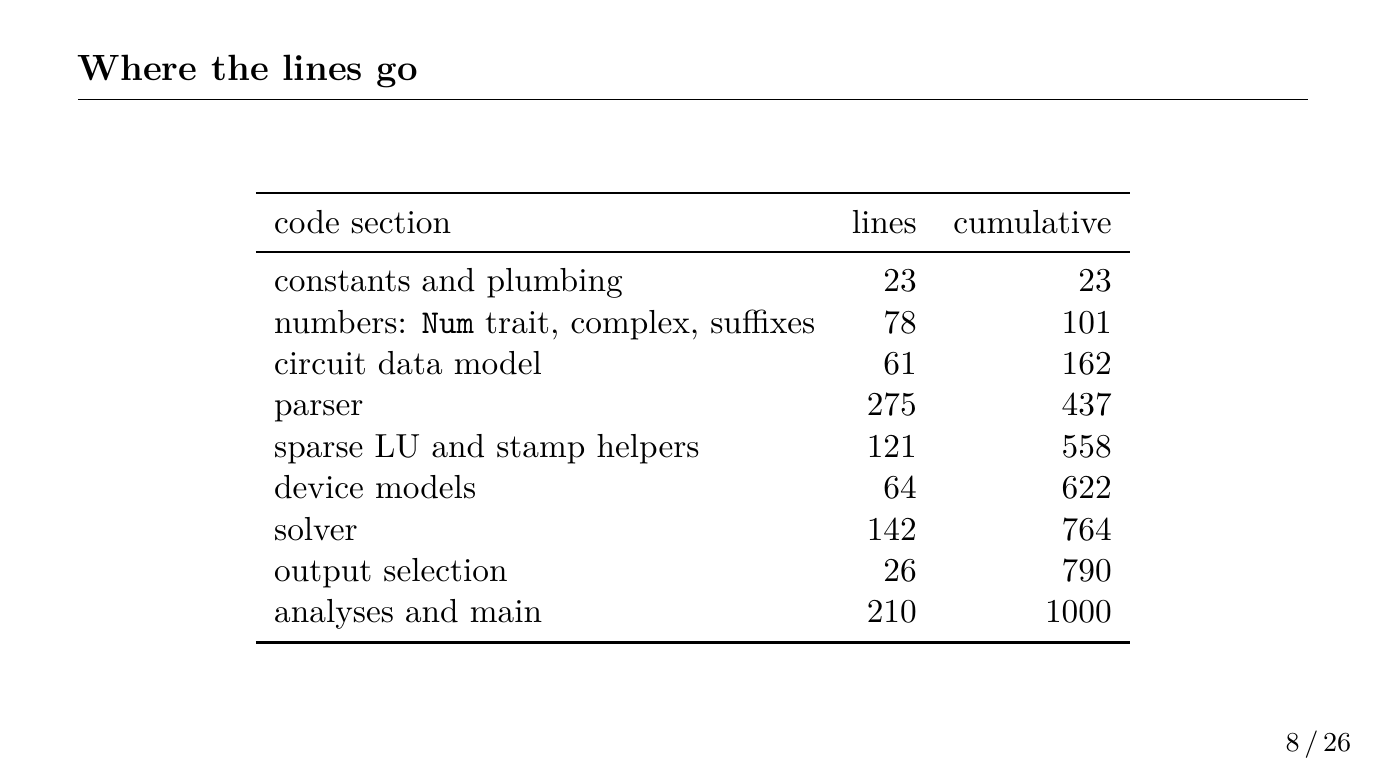
Reading netlists costs more code than solving them: the parser is the largest section in the file, ahead of the solver and the sparse LU, while all eleven device models together come to 64 lines.
History
After SANE I wanted to do a bit of classic SPICE, and talking to people from the SPICE world made the idea concrete. VACASK is around twenty thousand lines where ngspice is over half a million, which raised the question of how much further down it goes. How much do you actually need?
The cap is an older habit. On the Python version of PathSim I spent a long time holding everything under 2000 lines, after George Hotz's tinygrad. A thousand turned out to be enough here for the 1975 core, complete; the algorithm set is fifty years old and still carries a working simulator.
The report is sized to match, and so is the talk: thirty minutes, slides in the repository.
nanofem asks the same question of electromagnetic fields.